Tuesday, March 22, 2022

Ramble Report March 17 2022

Leader for today's Ramble: Linda
Link to Don's Facebook album for this Ramble. All the photos that appear in this report, unless otherwise credited, were taken by Don Hunter.
https://www.facebook.com/media/set?vanity=don.hunter.56&set=a.4987661561250369
Number of Ramblers today: 37
Today's emphasis: Plants flowering in the International Garden, Herb and Physic Gardens, Heritage Garden and Flower Garden
Readings: Bob Ambrose recited his poem, On the First Wave of Spring
Here is the link to his poem: https://bobambrosejr-poetry.blogspot.com/2018/03/on-first-wave-of-spring.html

Next, to commemorate St. Patrick's Day, David read two poems from Janisse Ray's House of Branches:

Eleventh

I know where
the ribbon snake
lives-------
under the maple
by the barn.
One day when I
was there
a dead leaf
crackled like fire
and I saw her,
slip of green
I followed
around the waist
of the tree,
through already
dying grass.
When she turned.
To face me, eyes
burning, she
studied me.
I - wanting
To feel her softness,
her certainty, the stove
of her tiny heart ---
touched one finger.
only one,
upon her perfect tail.
At that moment
the tree opened
and she wound
inside, her
passageway
dark and narrow.
Long before
I turned away,
no doubt
she lay
on her mat of earth
at the bottom
of the maple
among the roots
strip
of brilliant
kindling.
The eleventh
Commandment is
love the earth
love the tree
love the snake.

Psychoanalysis

What does it mean, Sigmund Freud,
that the snake was not in my dream
but in the hallway, a brown velvet rope
stretched across the runner.  It glimmered
like an Indonesian textile, new-
woven, lying across the path we travel
dozens of times a day between kitchen
and bedroom, front and back.
I called my husband, who
came from the porch and stood
opposite, length of perfect cord
between us.  Strange as it was,
we were stranger.  We watched,
only that, never moving
for broom or bag, no impediment.
We watched it glide across the floor,
behind a row of machines, hot water
heater, washer and dryer, through
a drift of spilled laundry powder, into
the accumulation of our lives, old
rag bag, dog shampoo, shoe polish,
spot remover, brushes and brooms,
window cleaner, jugs of vinegar,
ammonia and bleach.
Our lives are no place for you, beautiful,
this house no crevice in an old tree.
For your own sake, get out.
 
Show and Tell:

Chinese Violet Cress

Linda presented a sprig from one of the many Chinese Violet Cress currently seen in beds around the Garden.  A nearby sign called it “Color Up Purple,” one of the many cultivars of Wild Cabbage (Brassica oleracea). Wild Cabbage was selected and cultivated over many centuries to produce an amazing diversity of vegetables; e.g., cabbage, broccoli, cauliflower, kale, Brussels sprouts, collard greens, and kohlrabi. But the sign is for a plant that hasn’t yet appeared this year. The plant we actually examined is Chinese Violet Cress (Orychophragmus violaceus). It is in the same family as Wild Cabbage and has the same distinctive smell and taste and the same four-petaled flowers that earned this family the name “crucifer,” or cross-bearing. According to the Missouri Botanical Garden, Chinese Violet Cress “is native to roadsides, forests, fields, thickets, valleys, hillsides, sunny slopes and garden areas in central China. It is cultivated in China as a vegetable, with stalks typically harvested in the second year after flowering. Flowers and leaves are also edible and make tasty additions to salads.” Its invasive potential is unknown. Whether it is a larval host plant for our native butterfly, Falcate Orange-tip, is also unknown. Native crucifers provide early spring opportunities for this butterfly to lay its eggs.

Today's Route:  We left the Children's Garden, heading down the paved path, passing by the American South section, across the Flower Bridge and through the China and Asia Section.  From there we passed the Threatened and Endangered Plant bed, through the Native American Southeastern Tribes Section and into the Physic Garden.  We then took the connecting walk, past the Pawpaw Patch into the Heritage Garden, after which we walked through much of the Flower Garden, coming back through the Rose Terraces and Heritage Garden, again, and back out to the parking lot.

OBSERVATIONS:
Don and Heather conducted some pre-Ramble explorations and found several species of interest:
 
White-lip Globe Snail ?

A snail, possibly a
White-lip Globe Snail. That species was identified by Charles Wharton as one of seven species of land snail he found in his survey of the plants and animals of the State Botanical Garden.  
 
Flowering Dogwoods beginning to expand their showy, white bracts
 
An American Toad, nearly camouflaged in the mulch in one of the beds near the pergola.

The snail and the toad represent the beauty and the problem with iNaturalist. Many of the photos submitted were taken from the wrong angle for identification. Not the fault of the photographer, It's the nature of the subject. Snails, for example, are hard for experts to ID and the key features are hard, or impossible to see in photos of the living animal. 
The toad could be one of two species in our area: Fowler's Toad or American Toad. The easiest feature that discriminates between these species is the color of the belly -- Fowler's has a white belly, American has a darker underside with scattered spots. American also has enlarged warts on its calf and Fowler's has calf warts the same size as the rest of the leg. There is a ridge of skin behind the eye that contacts the large gland behind the eye on the shoulder in Fowler's. In the American the large gland is separated from the ridge or it may touch a rearward extension of the ridge. These features are very difficult is see, even in excellent photographs. Don tells me that INat identified the toad as a Southern Toad, but that species does not occur in our area; it's a coastal plain species.

Georgia Rock Cress

Georgia Rock Cress is planted along the paved path into the American South Section of the International Garden. This is one of the rarest species in Georgia, with only a handful of populations surviving in the northwest corner of the state near Rome and in the Fall Line, near Columbus. The plants seem to love rocky cliffs and bluffs, or perhaps they inhabit these stressful environments because there's little competition there. They are clearly flourishing in the rich beds at the Garden. As the name "Cress" indicates, this species is a member of the family Brassicaceae: its flowers are cross-shaped and its sap has the sulfurous smell and taste characteristic of this family. The compounds responsible for these distinctive tastes and smells evolved in this family as a way to discourage browsing animals; some people also find the taste bitter and the cooking odors revolting, while others welcome a plateful of collards or turnip greens on New Year's Day.


Chattahoochee Trillium 

A patch of four or five Chattahoochee Trillium is flourishing along the path into the International Garden; ramblers wondered how these plants got here. Not being a Piedmont native, this species is found at the Garden in the Dunson Native Flora Garden and environs. It's likely that a deer ate one of the fruits of the Dunson plants and later deposited the seeds here with its dung. It's also possible - though probably unlikely due to the distance involved - that the seeds were brought here by ants. Ants are the primary dispersal agent for Trillium seeds in the wild but typically don't carry seeds more than two meters. Each Trillium seed comes equipped with a fleshy attachment called an elaiosome that is rich in fat and other nutrients. The ants grab the elaiosome in their jaws and drag the seed into their nest. They feed the elaiosome to their larvae and carry the still intact seed to their waste dump, where the seeds find a nice rich bed (of ant poop and dead ant bodies) for germination. Unfortunately, the exotic invasive Red Fire Ant (Solenopsis invicta) competes with native ants for wildflower seeds and is not skilled at dispersing seeds, often destroying most of the seeds it gathers.

Photo by Douglas W. Jones of Trillium recurvatum seeds with pale-colored elaiosomes, https://en.wikipedia.org/wiki/Elaiosome

Yaupon Holly hybrid with yellow fruit, possibly 'Anna's Choice'. 

Virginia Bluebells, an early spring ephemeral, with its pink buds and blue, fully opened flowers.
Bees can't see in the red end of the spectrum but are attracted to the blue color of mature Bluebell flowers which they can see and which advertises the presence of nectar. The pink color may discourage nectar-robbing by bees, who are known to pierce the base of flower tubes to extract nectar before the flowers mature and produce viable pollen. However, the long floral tube and lack of a good "landing platform" limit the type of bees that visit these flowers. Only long-tongued bees can reach the nectaries hidden in the base of the tube and they must do so quickly since most bees are not good at hovering for more than a few seconds.


Pansy cultivars are planted along the Flower Bridge. All pansies originated as hybrids of several European species of violets (genus Viola), including Viola tricolor which has been flagged as an invasive in some parts of the U.S.

'Leonard Messel' Magnolia, a cultivar derived from crossing two Asian magnolias, Magnolia kobus and Magnolia stellata, and referred to as Magnolia X loebneri. Note that cultivar names are always enclosed in single quotation marks and are never in italics like scientific names.

Showy stamens of Alabama Snow Wreath flowers

As we approached the Alabama Snow Wreath hedge in the Threatened and Endangered Species Garden, Heather pointed out the calls of both the Red-tailed Hawk and the Red-shouldered Hawk in the woods to the right of the path. Alabama Snow Wreath flowers abundantly, but rarely produces viable seed.; it seems to reproduce only by the spread of rhizomes (underground stems). The flowers lack petals: their showiness is due to the long white stamens with their yellow anther tips. Alabama Snow Wreath is rare in Georgia, occurring naturally only in northwestern counties. It is rare throughout its range of Georgia, Alabama, Mississippi, Tennessee, Arkansas, and Missouri, but is widely available in the nursery trade.


Georgia Dwarf Trillium is an extremely narrow endemic, found only in one county in northwest Georgia. Several small populations are being safeguarded at the Botanical Garden, here in the T&E Garden and also in the Dunson Garden.

A Golden Ragwort flower head emerging from its protective covering of purple bracts. The purple pigment, anthocyanin, seen in the bracts and stem, acts as a kind of sunscreen to tender new growth.

Basal leaves of White Avens are mottled with silvery green and deeply divided into many segments. They bear little resemblance to the solid green, three-lobed stem leaves which will follow in early summer.

Amber Jelly Fungus, a wood-rotting fungus, appears in the winter on dead twigs and branches. It is a "resurrection fungus," with the capacity to dry to nearly nothing then rehydrate after a rain or even a heavy dew. They can also rebound after being frozen solid. The "fruiting," or spore-producing, bodies cover the glistening upper surface but are nearly invisible.

Rue-anemone (or Windflower) and Green-and-Gold are among the earliest wildflowers to bloom in Piedmont forests.

Rue-anemone flowers lack petals and depend on their bright white sepals to attract pollinators, which include various bees and flies. These plants typically flower early then disappear by late spring. Green-and-Gold flower heads are visited by a variety of insects and continue to produce flowers well into the summer

May-apple plants are emerging on "Native American Hill," near the base of the large boulder. Most plants are topped with a single leaf but a few plants have forked stems, with each of the two forks bearing a leaf. Between the leaves, a small bud is forming that will produce a flower in April and a fruit in May.

Russell discovered a fallen branch covered on one side with a variety of lichens, including Perforated Ruffle Lichen and Old Man's Beard, and on the other side with the beautiful golden-tan Wrinkled Crust fungus

Don's close-up photo of the Wrinkled Crust reveals the intricate patterns on its surface

Pawpaw trees are in bud, their hairy sepals protecting the six developing petals within.

The red-brick wall that connects the Physic Garden and the Heritage Garden is covered with Creeping Fig. Kathy pointed out that this species has a high potential to become invasive; she has seen it covering acres of land in a park in Florida.

Eastern Redbud, bright pink against the bright blue sky, is a classic north Georgia scene in March. Longleaf Pines in the fast-growing "rocket stage" are in the foreground.

One of the two honey bee hives in the Flower Garden recently swarmed, necessitating the insertion of a third hive to accommodate the new colony.

The leaves of Hyacinth and some other spring-flowering bulbs are hydrophobic, i.e. water-repelling, causing dew and rain to form shimmering beads on the waxy surface. Some of our native plants also have hydrophobic leaves, notably in the Piedmont, Jewelweed, which we will see in late summer. For an interesting explanation of hydrophobicity in plants, turn to Science Friday: https://www.sciencefriday.com/educational-resources/hydrophobicity-will-the-drop-stop-or-roll/

A large stand of a native Viburnum cultivar growing near the wildlife viewing platform on the north side of the Flower Garden is in full flower. Each flat-topped flower cluster consists of many small, white, five-petaled flowers with golden stamens.

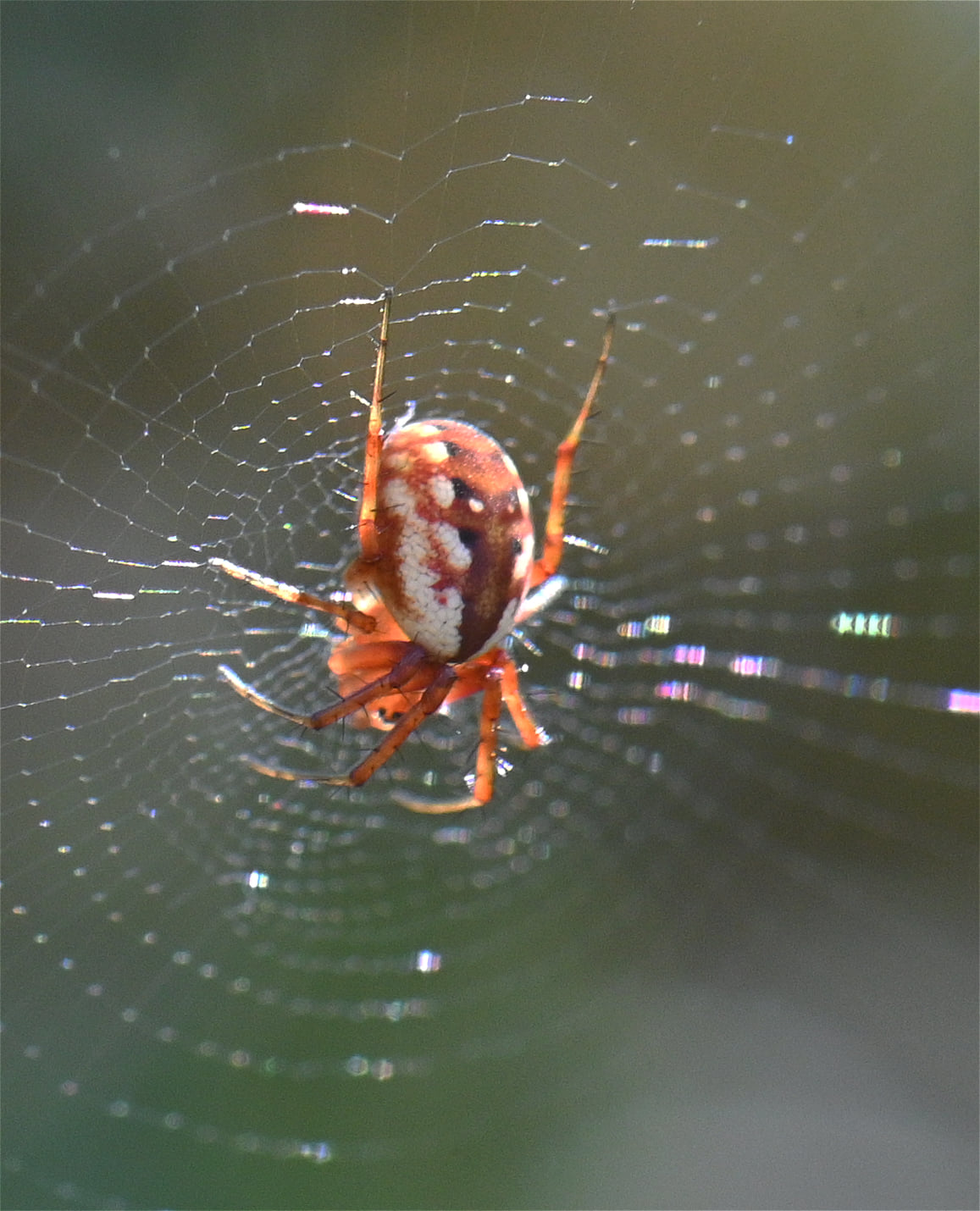
A Tuft-legged Orbweaver working her web in the hedges in the Heritage Garden. 

Making our way back to the parking lot after the ramble, some of us came upon several large red dumpsters. The south-facing side of one of the dumpsters was covered with a maze of slug grazing trails, where slugs have been dining on the algae (and possibly a few lichens) for months.  The patterns were quite beautiful, actually.

Don and Heather noticed several Carolina Anoles sunning and hunting prey in front of the Porcelain & Decorative Arts Museum. One stationed on the iron grate at a drain was dark brown to almost black, approximating the surrounding colors. Another stalking a wasp in a Spurge was the more typical green color.

OBSERVED SPECIES:


Chinese Violet Cress    Orychophragmus violaceus
White-lip Globe Snail??   Mesodon thyroidus
Dogwood     Cornus florida
American Toad     Anaxyris americanus
Oriental Paper Bush     Edgeworthia chrysantha
Georgia Rock Cress     Arabis georgiana
Chattahoochee Trillium     Trillium decipiens
Yaupon Holly     Ilex vomitoria 'Anna's Choice'
Sticky Catchfly/Wild Pink     Silene caroliniana
Virginia Bluebells     Mertensia virginica
Pansies     Viola x wittrockiana
Oconee Azalea     Rhododendron flammeum
Tea Camellia     Camellia sinensis
'Leonard Messel' Magnolia     Magnolia x loebneri
Creeping Mazus      Mazus reptans
Red-tailed Hawk     Buteo jamaicensis
Red-shouldered Hawk     Buteo lineatus
Alabama Snow Wreath     Neviusia alabamensis
Georgia Dwarf Trillium     Trillium georgianum
Rue Anemone     Thalictrum thalictroides (synonym: Anemonella thalictroides)
Golden Ragwort     Packera aurea
White Avens     Geum canadense
White Florida Anise     Illicium floridanum 'Alba'
Walter's Violet     Viola walteri
Amber Jelly Fungus     Exidia recisa
Wrinkled Crust Fungus     Phlebia radiata
Perforated Ruffle Lichen     Parmotrema perforatum
Old Man's Beard     Usnea strigosa
Green-and-Gold     Chrysogonum virginianum
Mayapple     Podophyllum peltatum
Bloodroot     Sanguinaria canadensis
Pawpaw     Asimina triloba
Creeping Fig     Ficus pumila
Eastern Redbud     Cercis canadensis
Western Honey Bee     Apis mellifera
Rabbit-eye Blueberry     Vaccinium ashei
Hyacinth        Hyacinthus orientalis
Viburnum     Viburnum sp.
Tuft-legged Orbweaver     Mangora placida
Carolina Anole     Anolis carolinensis


Monday, March 14, 2022

Ramble Report March 10 2022

Leader for today's Ramble: Dale
Link to Don's Facebook album for this Ramble. All the photos that appear in this report, unless otherwise credited, were taken by Don Hunter.
Number of Ramblers today: 15
Today's emphasis: Seeking what we find on the Purple Trail
Reading: Kathy Stege recited, from memory, Emily Dickinson's To Make a Prairie.

To make a prairie it takes a clover and one bee,
One clover, and a bee.
And revery.
The revery alone will do,
If bees are few.

Today's Route:  We made our way  through the Herb & Physic Garden to the Pawpaw patch, hoping to see flower buds. From there we embarked on the Purple Trail but ran out of time before reaching the river, so we returned 
 
OBSERVATIONS:
 
Pawpaw flower buds

Pawpaw trees have not yet appeared, but the flower buds are swelling and some are beginning to open.

Poison Ivy vine on tree trunk

Poison Ivy
is easily recognized in summer by relying on the old ditty: "leaflets three, let it be." But winter presents a problem. All parts of the plant can cause dermatitis in sensitive individuals.  That means you need to recognize the vine without its leaves. Fortunately, poison ivy vines are easily recognized. The vine climbs a tree by using numerous fibrous, hair-like rootlets that attach to the bark. You should avoid contact with the rootlets and vine -- all parts of the plant are capable of inducing a rash in sensitive individuals.

Signage: Throughout the Garden there are small aluminum signs that identify the nearby plants. Almost without exception these signs are vandalized, their borders scraped. The guilty party? Rodents, like squirrels or chipmunks. Unlike humans, rodent incisors continue to grow in length throughout their life. Continual usage wears the edges down, but sometimes they need a harder surface to keep the teeth from getting too long. If not maintained by constant wear the incisors would grow to long and the animal would starve to death.
.
Sap wells created by Yellow-bellied Sapsucker.

Sapsucker wells
We have visited this tree, a Hophornbeam, for many years. It's just one of its kind to be visited by a Yellow-bellied Sapsucker woodpecker, a winter visitor in these woods.
The Sapsucker finds a tree and begins to punch a shallow hole in its bark. When finished, the bird moves a short distance to the side of the first hole and repeats. Eventually it creates a ring of holes that ooze tree sap. The sapsucker sips the sap that oozes from the holes and, in addition, eats small insects that are attracted to the sugary fluid. Eventually the tree seals the holes and the bird moves up a short distance and makes a new series of wells.
 
Hop Hornbeam or Hophornbeam
This is a somewhat esoteric subject, so you might want to skip ahead to the next section. 
 
Regardless of dictionaries, we have in entomology a rule for insect common names that can be followed. It says: If the insect is what the name implies, write the two words separately; otherwise run them together. Thus we have such names as house fly, blow fly, and robber fly contrasted with dragonfly,  and butterfly, because the latter are not flies, just as an aphislion is not a lion and a silverfish is not a fish. The honey bee is an insect and is preeminently a bee; “honeybee” is equivalent to “Johnsmith.”

From Anatomy of the Honey Bee by Robert E. Snodgrass
 
So as far as trees are concerned the question is: is the tree we call a hophorbeam a hornbeam?
In Europe the trees called hornbeams are in the genus Carpinus, in the Birch family. The common name, "hornbeam", refers to the use of their wood to yoke a team of oxen for plowing. Thus, the hophornbeam in the genus Ostrya is not a true hornbeam. The common name for Ostrya virginiana should be hophornbeam.
Whether it should be hophornbeam or Hophornbean is a different matter.

Marcescence is a term that describes the retention of dead leaves by broad-leaved trees of the temperate zone. As autumn approaches most broad-leaved trees prepare for winter by shedding their leaves. (see Why trees drop their leaves for an explanation.)
As autumn approaches the chlorophyll and other substances are removed from the leaves for winter storage. At the same time the tree begins to seal off the leaf by creating a layer of cells called the abscission layer, to block the loss of water that would leak out of the tree. When the abscission layer is complete the leaf will eventually fall from the tree, breaking off at the abscission layer.
Except when it doesn't. Some trees retain all or man of their dead leaves throughout the winter. The phenomenon is called marcescence.  The trees in our area are Oaks, Hophornbeam, American Hornbeam, Chalk Maple, American Beech. Some don't retain all their leaves, slowly losing them during winter. This time of year when you drive into the Bot Garden the marcescent Beech leaves are very pale and those of the Hophornbeam are a darker brown. The colors are more prominent after a rain.
For a good summary of the possible adaptive significance of marcescence visit this page.
  
Lichens are composite organisms. They consist of a fungus (the mycobiont) and a photosynthetic unicellular organism (the photobiont).  Reproduction can be sexual or asexual. If sexual, there is a problem: only the mycobiont reproduces. The resulting spores have no photobionts. They must acquire them from the environment, otherwise the mycobiont will perish. Asexual reproduction is accomplished by packaging both the myco- and photo- bionts in the same reproductive propagule.

Perforated Ruffle Lichen


Script lichen closeup
The black squiggles are the places where sexual reproduction occurs, producing spores that contain only the mycobiont.


American Beech associates
The natural world is filled with interactions that occur so briefly that they are seldom seen. A hawk swoops in and plucks a bird from your bird feeder. You have to be there in the moment to experience that act of predation. Sometimes the interaction is more protracted or leaves evidence of having occurred. Like caterpillars eating the leaves of a plant. Today we saw evidence of such an interaction. We found a black, spongy mass on one of the small branches of an American Beech tree. Your first impression might have been that the fungus was eating the tree's leaves. But it is only growing ON the leaves, not consuming them. 
Black Sooty Mold on branch of American Beech
photo from Jan. 16, 2014, Ramble

       
Closeup of Black Sooty Mold showing sponge-like texture.

If you visited the Beech tree during the summer you would find a colony of aphids on the branches above the one the fungus is growing on. The aphids are sucking sap from the tree. Tree sap has sugar in it but is a poor source of amino acids, the building blocks of proteins. To get enough amino acids the aphids have to suck a lot of sap. This gives them more sugar than they need and the excess is excreted. We call it "honeydew" and you know how sticky it is if you've parked your car beneath an aphid-infested tree. 
The aphid colony grows throughout the summer and more and more honeydew is dropped below the colony. Sooty Mold spores eventually drift into the sweet spot below the colony and begin to grow, feeding on the carbohydrate riches. Their food is aphid poo, not Beech trees.
               
Beech Blight Aphids
photo taken on a previous summer Ramble
The aphids are covered with waxy secretions that protect them from predators.

We also found the remnants of a plant that is totally dependent on the Beech: Beech Drops. These flowering plants have become completely parasitic on Beeches -- they no longer have chlorophyll or leaves. Underground their roots have modified structures called haustoria that seek out Beech roots and fuse with them. 
Lacking chlorophyll means that the stems are no longer green. This makes them difficult to see against the background of fallen leaves. But if you get a search image in your mind you'll discover hundreds surrounding a single Beech.
Remains of last summer's Beech Drops


Slimy Salamander
body length approx. 2 inches

Slimy Salamander

We discovered a small, black salamander under a piece of decaying wood. Its body was speckled with tiny white dots, a characteristic of the Slimy Salamander. If you handled it you would discover how appropriate the common name is. The skin secretions are extremely sticky and very irritating; you don't want to touch your mouth or eyes after handling one.
The Slimy Salamander is a member of the largest salamander family, the Plethodontidae. Plethodontids have two major centers of diversity: the southern Appalachians and Central and South America. New species continue to be discovered, especially in South America.
The most unusual feature of the family is the absence of lungs.They get their oxygen exclusively through their skin and the lining of the mouth and pharynx.
Although some plethodontids lay their eggs in ponds and streams most lay their eggs in moist areas under rocks or decaying wood. For these terrestrial breeding species there is no aquatic phase in their life cycle. In many species the female remains with her clutch of eggs until they hatch. Because of their high moisture requirements they are active mostly at night. In the daytime they seek the cover of moist leaf litter and beneath or in decaying wood.
Plethodontids are surprisingly abundant. According to one classic study, the total biomass of plethodontid salamanders in their study area exceeded the total biomass of all the resident birds and mammals in that area.
 
Wood rotting fungi
Many pieces of fallen or cut wood support the growth of a variety of fungi. But we don't see the entire organism. What we see is called the fruiting body, the reproductive organ of a fungus. Hidden inside the wood is the body of the fungus. If out vision could penetrate the wood we would see, interlaced with the wood fibers, a dense network of delicate threads, intersecting, branching and twining about the wood cells they are digesting. It's like a plant whose only visible part is a flower. All the other parts, the stems, leaves, roots are invisible to us. What we see is the reproducive structure that doesn't make seeds -- it makes spores -- by the millions or billions.
The part hidden from our vision is the body of the fungus. It is called a mycelium and is made of cells that look like threads. The threads are called hyphae (singular: hypha). The hyphae elongate and branch, each hypha secreting a mixture of chemicals that will digest the wood cells it encounters. 
Our only clue to how this hidden part of the fungus occupies its piece of wood is to look at the fruiting bodies it produces. Each species and each variety will produce a fruiting body that appears different and we can infer what part of a log is occupied by their myceliums. 
There are at least two groups of fan-shaped fruiting bodies on this log. The gray-colored group on the top are Turkey Tails. The brown colored group below are Violet-toothed Polypores.

What happens when a dead log is colonized by different kinds of fungi? Do they harmoniously share the log? Or do they actively secure their part of the wood? We can't observe directly what goes on, but we can infer part of the interaction. It appears that Robert Frost was right: "Good fences make good neighbors." As the mycelia explore the wood and come into contact they start walling off their domain. One of the ways this is done is by synthesis of a dark pigment called melanin. (Yes, melanin is what makes our skin and hair brown or black. It's really a class of compounds that have similar properties.)
The defensive secretion of melanin leaves a trace of where mycelia  have met. Those pieces of wood are used by wood artisans to make specialty wood items like turned bowls or violins. Such wood is known as "spalted" and an example is seen below. The right side of the wood slice shows several areas delimited by heavy dark lines. Within each delimited area the different colors, light, pale tan, or darker brown reflect the different type of fungi that "own" the circumscribed area, In the lightest area the fungus was digesting the lignen, leaving behind the lighter colored cellulose.
 
Spalted 'beech cross section
The heavy dark lines are the pigments produced by "warring" mycelia
photo by M J Richardson via Wikipedia Commons.
 
For more photographs of today's Ramble visit this page.

SUMMARY OF OBSERVED SPECIES:

Turkey Tail Fungus     Trametes versicolor
Violet-toothed Polypore     Trichaptum biforme
Carbon Balls     Daldinia concentrica
Perforated Ruffle Lichen     Parmotrema perforatum
Veitch's Winterhazel     Corylopsis veitchiana
Pawpaw     Asimina triloba
White Oak     Quercus alba
Poison Ivy     Toxicodendron radicans
American Beech     Fagus grandifolia
Script lichen     Graphis sp.
Changeable Mantleslug     Megapallifera mutabilis
Yellow-bellied Sapsucker     Sphyrapicus varius
Hophornbeam       Ostrya virginiana
American Holly tree     Ilex opaca
Speckled Blister Lichen     Viridothelium virens
Elliott's Blueberry     Vaccinium elliottii
Northern Red Oak     Quercus rubra
False Turkey Tail fungus     Stereum lobatum
Coral Pink Merulius     Byssomerulius incarnatus
Hypoxylon Canker      Biscogniauxia (Hypoxylon) atropunctatum
Slimy Salamander     Plethodon glutinosus
Black Sooty Mold     Scorias spongiosa
Beech Drops     Epifagus virginiana
Ceramic Parchment Fungus     Xylobolus frustulatus


Monday, March 7, 2022

Ramble Report March 3 2022

Leader for today's Ramble: Linda
Link to Don's Facebook album for this Ramble. All the photos that appear in this report, unless otherwise credited, were taken by Don Hunter.
Today's report: was written by Linda and Dale, based on notes taken by Don.
Number of Ramblers today: 43
Today's emphasis: Plants emerging in the Dunson Native Flora Garden.
Reading: March 1st entry from An Almanac for Moderns by Donald Culross Peattie. and modified to be gender neutral.
March First
Now is that sweet unwritten moment when all things are possible, are just begun. The little tree has not quite leafed. The mate is not yet chosen. To the ramblers in the woods all that they can find in heavy books will be of less worth than what they learn by sitting on a log and listening to the first quiver of sound from the marshes, or by prodding with a stick at the soil and turning out the sluggish beetles. It is good enough just to sit still and hold your palm out to the sunlight, like a leaf, and turn it over slowly, wondering:
What is light? What is flesh? What is it to be alive?

Show and Tell: 
Thorny Olive "cane" hanging on the beam where Gary threw it.

Gary Crider, one of our long time Ramblers, brought us a single "cane" from a Thorny Olive, Elaeagnus pungens, (pronounced: E-Lee-ag-nus pun-gens). Thorny Olive is an invasive plant species and Gary removes it for the Garden. He brought a long shoot that had numerous short side shoots, each ending in a leaf. Each of the side shoots was inclined downward which enables the longer stem to hook over the branches of surrounding trees. Gary demonstrated how this enables the plant to literally climb into a tree by throwing his sample into the air under the pergola. Sure enough, one of the side shoots hooked over one of the pergola beams.

Today's Route:   From the Children's Garden pergola we headed down the sidewalk through the Lower Shade Garden, leaving the sidewalk at the mulched path that leads down to the Dunson Native Flora Garden.  We moved through most of the garden paths before returning to the Children's Garden.
 
OBSERVATIONS:

Anthocyanin. 
Robert Frost’s famous poem, Nothing Gold Can Stay, always comes to mind this time of year, when every twig and bud seems ready to burst into life. Here is the first stanza of the poem:
 
Nature’s first green is gold,
Her hardest hue to hold.
Her early leaf’s a flower;
But only so an hour.

And yet to my eye, here in the Georgia Piedmont, nature’s first green is…red. From the blush pink of the Piedmont Azalea’s bud scales to the scarlet blaze of Red Maple flowers and fruits to the deep burgundy of Painted Buckeye’s emerging leaves, red is the color of early spring. We owe these fleeting hues to a plant pigment called anthocyanin.

Everyone knows about chlorophyll, the pigment that gives plants their greenness. We learn in basic biology classes that chlorophyll absorbs red and blue wavelengths of light and reflects the green wavelengths back to our eyes. Less well known and understood is another plant pigment called anthocyanin. Although debate still rages in the pages of botanical journals, there is an emerging consensus that anthocyanins are not just incidental byproducts of plant biochemistry, as previously thought, but are in fact critical to the survival of many plants. More and more roles for anthocyanin are being identified, among them: alerting migratory birds to autumn fruits hidden among red and orange leaves; warning hungry insects away from possibly toxic leaves and fruits; and, camouflaging leaves to some color-blind mammal herbivores.

In early spring, anthocyanin appears to play the important role of protecting tender new growth from sun damage. New growth in our Piedmont forests emerges while the canopy is still bare, allowing strong white light to reach the forest floor. To a certain degree, this is good: photosynthesis can gear up and plant growth and reproduction can commence. But too much of this good thing can inhibit the plant’s ability to conduct photosynthesis. Anthocyanin limits the amount of light that reaches the plant’s photosynthetic machinery by reflecting the red and blue wavelengths and by absorbing ultraviolet radiation.

Pink bud scales of the Piedmont Azalea protect developing tissues

Camellia flowers with showy stamens are luring several pollinators, including Western Honey Bees and Common Flower Flies.
 
Camellia flowers with stamens may produce fruit in late summer. However, some of the Camellia varieties in the Shade Garden have “doubled” flowers that are prized by horticulturists. Doubled flowers have lost their stamens due to a mutation that converts stamens into petals; mutated plants are then selectively bred for the nursery trade. Doubling has been known to horticulturists since the 3rd century BC and is responsible for many popular ornamentals such as roses and carnations. Doubled flowers are of no interest to insects since the nectaries are covered by petals and the pollen-producing stamens are nonexistent.

Common Flower Fly drinking from a large water droplet on a Camellia leaf.
 
Chattahoochee Trilliums are always the first trillium to flower in the Dunson Garden.

Chattahoochee Trillium is native to the Coastal Plain of southwest Georgia and adjacent parts of Florida and Alabama. Its early emergence in the Piedmont testifies to its deep south origin. It is distinguished by its long stalk, almost twice as long as its leaves, and by the bright silvery-white stripe down the midvein of each leaf. Here in the Dunson Garden, it has been brought together with the Sweet Betsy Trillium, a Piedmont species that has shorter stalks and no midvein stripe, a co-occurrence that is rare in the wild. Trilliums in Dunson that seem to have traits of both these species are probably hybrids. Note the deep red of the stems–anthocyanin at work!

Sweet Betsy Trillium has mottled leaves and sessile flowers but lacks the silvery stripe down the midvein. 
 
Chattahoochee Trillium and Sweet Betsy Trillium belong to the subgroup within the genus Trillium that has mottled leaves and flowers that sit directly on top of the leaves (sessile flowers). The flowers range in color from deep maroon to a bronzy yellow. Georgia has about 24 Trillium species, more than any other state; about 12 species of these are sessile trilliums.

Leaf of Painted Buckeye emerging from the protection of its red and green bud scales. Buckeyes have opposite twigs and leaves; this pattern can also be seen in the arrangement of the bud scales. 
 
Golden Ragwort buds enclosed by purple-tinged bracts.

The bracts – small, leaf-like structures -- that enclose the flower heads of Golden Ragwort are suffused with reddish purple anthocyanin pigments that protect the developing flowers within from sun damage. Interestingly, the basal leaves (not shown here) are also tinged with purple on the lower surface. The function of anthocyanin on the undersides of leaves (such as those of Cranefly Orchid) is still being researched.
 
Flowers of Leatherwood are narrow tubes with four shallow lobes at the tips. The flowers are visited by bees – a honeybee in this photo – that gather nectar from the base of the flower and pollen from its eight protruding stamens.

Leatherwood is a deciduous shrub in the Thymelaceae family, and is the only native member of this family in the U.S. (Edgeworthia or Paper-bush, an ornamental exotic shrub whose incredibly fragrant flowers perfume the winter garden, is also in this family.) Leatherwood occurs infrequently in moist deciduous forests from the Florida Panhandle north to Nova Scotia and southern Quebec. Named for its flexible stems and very tough bark, Leatherwood was used by Native Americans for making baskets, bow strings, sandals, and rope.
 
Spring Beauties, a true harbinger of spring at the Botanical Garden, opened its tiny pink and white flowers this week. 

Virginia Spring Beauty with narrow leaves and Carolina Spring Beauty with diamond-shaped leaves both occur in the Dunson Garden. They are “spring ephemerals,” plants that emerge in early spring, quickly flower and fruit, then disappear, having completed their entire life cycle in the space of a few weeks. The flowers are visited by both female and male Spring Beauty Bees (Andrena erigeniae) which collect pollen only from Spring Beauties. The female bees form the pink pollen into balls and deposit them in underground chambers along with their eggs. As temperatures warm, the larvae emerge and eat the pollen balls. The larvae pupate during the summer and develop into adults by late fall. Adults spend the winter underground, emerging in the spring when they mate on the petals of Spring Beauties.
Walter’s Violet flowers are small, blue or purple, with a white throat.
 
Walter’s Violet is an early spring bloomer. Its runners spread from a cluster of leaves, forming small colonies. The heart-shaped overwintering leaves are dull green with dark veins; the lower leaf surface usually has purplish veins or a tinge of purple near the base. The leaf tips are rounded and the margins are finely toothed. This is an easily overlooked plant with small blue flowers and is often mistaken for the much larger, glossy-leaved Common Blue Violet (Viola sororia).

A new Bloodroot flower emerging from a furled leaf.:

Cut-leaf Toothwort is coming into its own, with its pink, anthocyanin-protected buds opening into white flowers.

Cut-leaf Toothwort is a member of the Brassica (Mustard) family that includes many of our cool season vegetables such as mustard and collard greens. Toothwort’s leaves and underground stems are also edible, with a sharp taste much like turnips.

Male Falcate Orangetip butterfly. The females lack the orange coloration.
Photo by Andy Reago & Chrissy McClarren, CC BY 2.0 , via Wikimedia Commons.


Plants of the mustard family contain compounds called glucosinolates that give them a pungent taste. But some herbivores have evolved ways to eat mustards. One of our butterfly species, the Falcate Orangetip, emerges in early spring and searches for mustards like toothworts to lay their eggs on. Although we did not see one today, Orangetips have been seen in the Dunson Garden before. Look for them during the next two weeks.


A group of Trailing Trillium hugging the ground.

Trailing Trillium or Decumbent Trillium
. A small cluster of Trilliums appeared to be stemless, the leaves hugging the ground. But they do have stems - they are just lying flat on the ground. That's where the "decumbent" in the specific name comes from.  When the stem emerges from the ground it bends 90 degrees and further elongation results in it creeping along under the leaf litter. After growing horizontally several inches the bud end bends 90 degrees upward and emerges through the leaf litter.

Green and Gold
Normally there are five yellow florets.


Green and Gold
. This link to the Clemson University Factsheet for Green and Gold is a gold mine of information about the varieties, propagation and characteristics of this winter-green species. It can be used as a ground cover in place of plants like English Ivy.
Flower buds of Dwarf Pawpaw

Dwarf Pawpaw
(Asimina parviflora) is the smaller, shrubbier cousin to the bigger Pawpaw, Asimina triloba. In both species the flower buds open before the leaf buds swell. The buds will open soon, if the warm weather keeps up. The petals are a deep wine red or purple in color. This reminded early investigators of rotting meat and they assumed that carrion flies were the chief pollinators. But, more recently, chemical analysis of the volatile compounds emitted by the flowers is more consistent with fermentation. It seems likely that the principle pollinators are flies and midges that feed on fermenting plant material.
The larger Pawpaw species is not planted in the Dunson Garden, but a "Pawpaw patch" can be found next to the sidewalk across from the Heritage Garden.

Georgia Dwarf Trillium


The leaf lobes of Sharp-lobed Hepatica are not as rounded as those of its close relative, Round-lobed Hepatica.


Flowers of Little Brown Jugs are under the leaf litter. These are pink (with anthocyanin?) and should turn brown later.

Little-brown Jug
hides its flowers under the leaf litter.
Why would any plant bury its flowers out of sight? Flowers are supposed to attract pollinators like bees, flies, butterflies or moths. Hiding the flower under dead leaves would seem a poor strategy for attracting pollinators. 

How do we discover what pollinates a flower? Normally you sit and watch, but that strategy fails when the flower is out of sight. If you remove the litter so that you can see the flowers you disturb the area so much that the normal pollinators, whatever they are, may not appear. So people who have investigated this question have resorted to indirect methods. They have enclosed the plants or just the flowers in cages that exclude insects to see if seeds are still produced. Caged plants do produce seeds, but not as many as uncaged plants. This indicates that these flowers are capable of self-pollination, but that more seed can be produced when pollinators are have access to the flowers. The actual pollinators remain unknown, but possible candidates are ants, beetles or fungus gnats.
 
A tachinid fly visiting the staminate (male) flowers of a Spicebush. All the flowers of a single plant are of the same sex.

Female flowers of Spicebush. The pistils with their style and stigma are clearly visible. All the flowers on a single Spicebush plant are the same sex.

Spicebush
is an early blooming shrub that is unusual in having the sexes on separate plants. Approximately 7% of the flowering plant species have this arrangement of the sexes. 
Mary Anne Borge has a beautifully illustrated blog post that explores the Spicebush and its interactions with other organisms. All Ramblers should take a look; it can be found at this link. 
 
Seersucker Sedge inflorescences
Staminate florets on top, Pistilate flowers below


Pistilate florets close up

Staminate florets closeup

Seersucker sedge
, like other sedges, is monoecious, bearing different sexes in different areas.

Gender arrangements in flowering plants.
The typical flower, as taught to most of us at an early age, has two reproductive parts: the stamens and the pistil. The stamens produce pollen and are usually considered the plant's male reproductive structures. The pistil (or pistils) produce the seeds, so they are considered to be the female structures. The "typical" flower has both stamens and pistils. Such a flower is termed bisexual or "perfect" and the plant that bears such flowers is termed "hermaphroditic."
 
Those of you who have grown zucchini may have observed that only some flowers on a plant produce a squash. They are the ones that have a swelling at the base of the flower. The swelling is the ovary, the part of the pistil that produces the seeds and the squash. Those other flowers have stamens but no pistils. The flowers in plants like zucchini are all unisexual, i.e., not "perfect." 
 
A plant with imperfect flowers of both sexes is termed "monoecious," (pronounced: "moan-EE-shus").
 
Examples of monoecious plants are: oaks, corn and sedges,
 
A third arrangement of genders in plants is found in Spicebush: all flowers are unisexual and each plant has flowers of one sex only. This condition is termed "dioecious", pronounced: "dye-EE-shus."
 
Examples of dioecious plants are: hollies, Spicebush and Wax Myrtle. 
 
Why so many gender arrangements? One of the things that may play a role in the evolution of monoecy and dioecy is the avoidance of self-fertilization. All plants and animals carry recessive genes that are unfavorable when brought together. Self-fertilization greatly increases the chances producing such genetic problems and monoecy and dioecy reduces those chances. But what about hermaphroditic plants? They reduce the chances of producing unfavorable genetic combinations by self incompatibility. In many plants self-pollen will be prevented from fertilizing ovules of the same plant. 

Virginia Bluebell flower buds are pink but change color to blue when opened.

Virginia Bluebells
Rue Anemone

Rue Anemone
is found scattered throughout the Dunson Gardem. Larger areas of abundance can be found along the Orange Trail and the White spur Trail.

Carolina Anole

Carolina Anoles
become active with warmer temperatures. They change color from brown to green and vice versa. It is thought that the brown color phase helps absorb heat from the sun. The change from one color to another is not immediate, it takes about 5 to 10 minutes, depending on temperature. The green color is thought to be concealing coloration when clambering among vegetation. They also are green when stressed. These ideas are best thought of as hypotheses, rather than proven facts.

SUMMARY OF OBSERVATIONS

Piedmont Azalea             Rhododendron canescens
Camellia                          Camellia japonica
Western Honey Bee        Apis mellifera
Common Flower Fly        Syrphus ribesii
Chattahoochee Trillium   Trillium decipiens
Painted Buckeye             Aesculus sylvatica
Florida Anise                   Illicium floridanum
Sweet Betsy Trillium       Trillium cuneatum
Golden Ragwort              Packera aurea
Black Cohosh                  Actaea racemosa
Leatherwood                   Dirca palustris
Carolina Spring Beauty   Claytonia caroliniana
Virginia Spring Beauty     Claytonia virginica
Walter's Violet                  Viola walteri
Bloodroot                         Sanguinaria canadensis
Trailing Trillium                Trillium decumbens
Cut-leaf Toothwort           Cardamine concatenata
Green-and-Gold              Chrysogonum virginianum
Dwarf Pawpaw                Asimina parviflora
Georgia Trillium               Trillium georgianum
Sharp-lobed Hepatica      Hepatica acutiloba
Allegheny Spurge            Pachysandra procumbens
Little Brown Jugs             Hexastylis arifolia
Spicebush                        Lindera benzoin
Rue Anemone                 Thalictrum thalictroides
Carolina Anole                 Anolis carolinensis
Seersucker sedge            Carex plantaginea


Monday, February 21, 2022

FINE Things 63

How lizards shed their tails. (Video and text) [link]
 
Do birds have "culture"? Find out by viewing this webinar. [link]

The calorie counter. Evolutionary anthropologist Herman Pontzer busts myths about how humans burn calories-and why.
[link]

February 22, 2022: A Twos Day on a Tuesday. The date, when written in the m-dd-yy format, consists only of twos: 2-22-22. It also falls on a Tuesday! From:
[link] 

How warp-speed evolution is transforming ecology. Darwin thought evolution was too slow to change the environment on observable timescales. Ecologists are discovering that he was wrong.
[link]

From Linda: A parasitic wasp unmasked: one species is actually 16 species.
[link]

What drives sea level rise? US report warns of 1-foot rise within three decades and more frequent flooding. A sea level scientist explains the two main ways climate change is threatening the coasts. [link]

How poisonous mercury gets from coal-fired power plants into the fish you eat. The Biden administration is moving to revive mercury limits for coal-fired power plants. A scientist explains mercury's health risks and the role power plants play. [link]